

China Top File Cabinet Manufacturers How to Choose?

Choosing a China-based File Cabinet manufacturer requires more than comparing catalog prices. It requires evidence.

Grand View Research estimated the global office furniture market at approximately USD 54 billion in 2023. Its report also projects steady growth through 2030. This expansion creates more supplier choices, but it can hide major quality differences. CSIL’s World Office Furniture research identifies China as a significant production and export hub. However, market size does not prove factory reliability. That distinction matters.

An experienced buyer should examine steel thickness, weld consistency, powder-coating coverage, drawer alignment, and lock performance. Small details matter. Ask for material certificates, factory audit records, product test reports, and recent export references. Request close-up photographs of drawer runners and cabinet corners. A polished website proves little.

Check whether the manufacturer operates under a documented quality system, such as ISO 9001. For workplace storage, also review applicable standards, including EN 14073 requirements where relevant. Destination-market safety and chemical regulations must guide the final decision. Do not assume one certificate covers every country.

Compare samples before approving a large order. Measure the cabinet, open each drawer repeatedly, and inspect the coating under bright light. The cheapest quotation can become expensive through damage, replacement, and delayed delivery. That is not always obvious at the beginning.

A strong supplier should explain steel grades, production capacity, packaging methods, warranty terms, and corrective-action procedures. Request a written inspection plan. Then verify it independently when possible. Some factories will look excellent during a video call. A physical audit may still reveal weaknesses. That uncomfortable possibility deserves attention. Reliable selection combines report-based research, hands-on testing, transparent communication, and careful reflection.
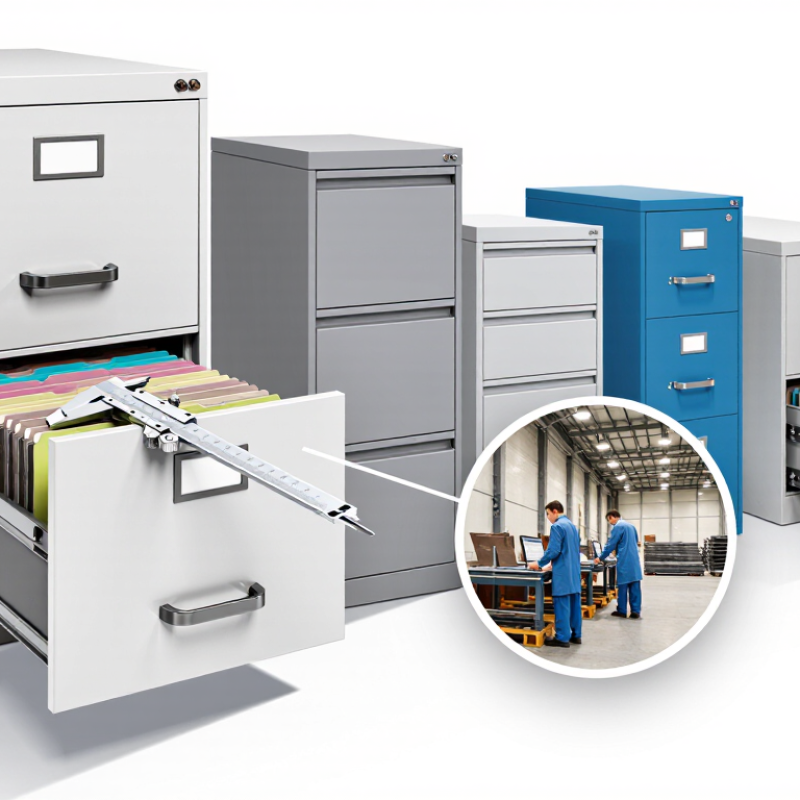
China Top File Cabinet Manufacturers How to Choose?

Define Filing-Cabinet Types, Capacity, and Standard Steel Thickness of 0.6–1.2 mm

China Top File Cabinet Manufacturers: How to Choose?

Choosing a file cabinet starts with its type, not its appearance. Vertical cabinets suit narrow offices and store folders in deep drawers. Lateral cabinets hold files side by side, making daily retrieval faster. Mobile cabinets save floor space but need stable rails and careful weight distribution. Measure your folders, available wall space, and walking clearance before comparing suppliers.

Capacity should be checked by usable drawer width, depth, and load rating. A cabinet may look large but lose space through thick runners or internal frames. For routine records, estimate current files and add room for future growth. Leave some empty space. Overfilled drawers jam easily and create unnecessary stress on the cabinet structure.

Steel thickness commonly ranges from 0.6 to 1.2 mm. A 0.6 mm panel can suit light office use when reinforced with folded edges and strong runners. Thicker 0.8–1.0 mm steel offers better resistance for frequent opening and heavier files. Around 1.2 mm may support demanding environments, but thickness alone does not prove quality. Check weld points, drawer alignment, anti-tilt mechanisms, surface coating, and tested load data.

In practical inspections, a thin panel with poor reinforcement often feels weaker than expected. I have also seen heavy cabinets with disappointing drawers. That detail deserves attention. Ask for material certificates, dimensional drawings, and sample testing before placing a large order.


Verify Factory Credentials Through ISO 9001, GB/T 13668, and Production Data

China Top File Cabinet Manufacturers: How to Choose?

A reliable file cabinet manufacturer should provide more than attractive product photos. Request a current ISO 9001 certificate and check its scope, address, validity, and issuing organization. The certificate should cover manufacturing, not only sales or trading activities. Ask how corrective actions are recorded after internal audits. This reveals whether the system works beyond paperwork.

GB/T 13668 is another important reference for steel filing cabinets in China. Confirm which edition applies and whether the tested cabinet matches your requested model. Review reports for load capacity, drawer operation, stability, coating adhesion, and safety performance. Do not accept a report with unclear product descriptions. Small differences matter.

Production data can expose the factory’s real capability. Ask for monthly output, equipment lists, inspection records, material thickness, and recent defect rates. A serious factory can show batch numbers, steel purchase records, and final inspection results. Visit the workshop if possible. Look at welding points, powder coating lines, and packaging damage.

Numbers can mislead.

A large stated capacity may represent an ideal month, not normal production. I once focused too heavily on certificates and overlooked inconsistent drawer alignment. That mistake changed my evaluation method. Now I compare documents with physical samples, worker procedures, and shipment records. No verification method is perfect, but several matching sources provide stronger evidence than one polished file.

Compare MOQ, Lead Time, Defect Rate, Warranty, and Five-Year Ownership Cost

China Top File Cabinet Manufacturers: How to Choose?

MOQ affects more than purchase price. A low MOQ reduces inventory risk, but may increase unit cost. A high MOQ can lower pricing while tying up cash and warehouse space. Ask for production capacity, material certificates, and a sample approval process. The World Bank’s 2023 Logistics Performance Index rates shipment timeliness from 1 to 5. Country differences can make a quoted 30-day lead time unreliable. Request separate timelines for production, inspection, and shipping.

Defect rate needs careful reading. An AQL figure under ISO 2859-1 is a sampling limit, not a guaranteed factory defect rate. Require recent inspection records and define major defects clearly. A scratched drawer, loose lock, or uneven coating creates real replacement costs. The American Society for Quality reports that poor quality can consume a significant share of operating revenue, although the exact percentage varies by industry. That range is easy to underestimate. My own purchasing rule is to test a pilot batch before committing to a full container.

Warranty length matters, but response terms matter more. Request written coverage for locks, hinges, welds, coating failure, and replacement freight. Calculate five-year ownership cost using purchase price, shipping, installation, expected replacements, warranty exclusions, and disposal. Deloitte’s 2024 Global Chief Procurement Officer Survey highlights continuing pressure on cost and supply resilience. A cheap cabinet with a high failure rate may become expensive by year three. Forecasts are imperfect. Add a small contingency instead of trusting the lowest quotation.

Audit Load, Lock, Corrosion, and Fire Performance Against ANSI/BIFMA Standards

When choosing a China-made file cabinet, audit the test evidence, not only the product photographs. ANSI/BIFMA X5.9 evaluates storage-unit performance, including functional loads, stability, durability, and component operation. Request the exact standard edition, test date, cabinet configuration, and laboratory identity. A report for one drawer model may not support another. That small detail is often missed.

Load testing should reflect real office use, including unevenly filled drawers and repeated opening cycles. Check whether the lock remains functional after impact, misalignment, and thousands of cycles. Security claims need clear test methods. “High security” is not a measurable specification by itself. Corrosion also deserves practical inspection. The NACE IMPACT study estimated global corrosion costs at about 3.4% of global GDP. Ask for salt-spray evidence under ASTM B117 or ISO 9227, while checking welds, drawer rails, and uncoated edges.

Fire performance requires extra caution. ANSI/BIFMA storage standards do not automatically create a fire-resistance rating. For document protection, verify testing against a relevant method, such as UL 72, and confirm the tested internal temperature and duration. NFPA’s 2022 U.S. Fire Loss report recorded approximately 1.50 million fires and 26.6 billion dollars in direct property damage. A fire label without a complete report is weak evidence. I would also inspect samples personally; paperwork can look excellent, yet a drawer may still bind when loaded.

China Top File Cabinet Manufacturers How to Choose? - Audit Load, Lock, Corrosion, and Fire Performance Against ANSI/BIFMA Standards
Evaluation Area Audit Metric Recommended Procurement Benchmark Relevant Standard or Test Reference Evidence to Request from the Manufacturer Suggested Weight
Structural Load Static load capacity Verify the declared load for the complete cabinet, shelves, drawers, runners, and base. The unit should sustain the specified load without permanent deformation, cracking, loss of alignment, or unsafe operation. ANSI/BIFMA X5.9, Office Storage Products. Use the applicable edition and product category test procedure. Third-party test report identifying the exact model, configuration, loading method, test duration, acceptance criteria, and observed deformation. 15%
Drawer Performance Opening, closing, and cycle durability Drawers should open smoothly under the declared working load, remain properly guided, and complete the specified durability cycles without runner failure or detachment. ANSI/BIFMA X5.9 drawer operation and durability provisions, where applicable. Laboratory report, runner specification, cycle count, working-load condition, and maintenance requirements. 10%
Tip-Over Safety Stability with drawers extended The cabinet should remain stable when drawers are opened in the prescribed sequence and when loaded according to the applicable test procedure. An interlock should prevent simultaneous opening of incompatible drawers. ANSI/BIFMA X5.9 stability and interlock provisions; applicable local safety requirements should also be reviewed. Stability test report, interlock drawings, anti-tip mechanism description, and installation instructions. 15%
Lock Security Locking function and key control All intended drawers or compartments should lock reliably. The lock should resist normal forced operation, key removal should function as designed, and replacement keys or cylinders should be controllable. ANSI/BIFMA X5.9 locking-related provisions where applicable; use a recognized security test specification for higher-security applications. Lock test report, cylinder or electronic-lock specification, key-differentiation information, master-key policy, and failure-rate records. 12%
Corrosion Resistance Salt-spray and coating durability For indoor office use, require a documented coating system and a corrosion test appropriate to the environment. Any salt-spray duration must be stated together with the substrate, pretreatment, coating thickness, scribe method, and acceptance rating. ASTM B117 or ISO 9227 for neutral salt-spray exposure. These are corrosion-test methods, not ANSI/BIFMA performance standards. Coating supplier data, pretreatment process, dry-film thickness records, test photographs, exposure hours, and evaluation method such as ASTM D610 or ISO 4628. 12%
Fire Performance Fire-resistance rating and temperature protection Do not treat a standard steel office cabinet as fire-rated. For document protection, specify a tested fire-resistance class, such as a 1-hour or 2-hour rating, only when the complete cabinet model has been tested and certified for that rating. UL 72 for record-protection equipment; ASTM E119 or equivalent fire-resistance methods may apply to building assemblies. ANSI/BIFMA does not by itself establish a fire-resistance rating for file cabinets. Certification listing, full-scale test report, rating class, internal temperature limit, document-media classification, door/lock configuration, and installation restrictions. 16%
Material and Fabrication Steel grade, thickness, welds, and dimensional control Require traceable material specifications and consistent panel thicknesses for the intended load. Welds, folded edges, spot-weld spacing, drawer fit, and surface preparation should be verified by incoming and final inspection. Manufacturer-controlled drawings and inspection plans; relevant material and coating standards should be stated in the technical file. Bill of materials, steel mill certificates, approved drawings, weld inspection records, dimensional inspection reports, and change-control procedure. 10%
Ergonomics and Usability Handle force, noise, clearances, and accessibility Handles should be free from sharp edges; drawers should move without binding; clearances should prevent finger-trap hazards; labels and operating instructions should be durable and legible. ANSI/BIFMA product-safety and usability provisions where applicable; review local accessibility and workplace-safety requirements. Ergonomic inspection checklist, force measurements, edge-radius or sharp-edge inspection, user instructions, and representative production samples. 8%
Factory Quality System Process control and product consistency The factory should control incoming materials, welding, pretreatment, powder coating, assembly, final inspection, nonconforming products, and corrective actions using documented procedures. ISO 9001 certification may support the evaluation but does not replace product testing or factory verification. Valid certification scope, process flow chart, control plan, inspection records, calibration certificates, corrective-action reports, and production traceability samples. 7%
Compliance Documentation Report validity and model traceability Test evidence should match the supplied model, dimensions, materials, hardware, lock type, drawer configuration, and manufacturing site. Reports should be issued by an identifiable competent laboratory. Applicable ANSI/BIFMA, UL, ASTM, ISO, or national standards must be identified by title, edition, and test scope. Signed test reports, laboratory accreditation details, product photographs, serial-number traceability, technical drawings, and a declaration of unchanged construction. 5%

Scoring guidance: Score each category from 0 to 5, multiply by the suggested weight, and require a corrective-action plan for any critical failure. ANSI/BIFMA X5.9 is primarily an office-storage performance standard; corrosion and fire protection require separate test methods and certification evidence. Always verify the current standard edition and the exact product configuration before purchase.

Rank Manufacturers with a Weighted Scorecard: Quality 40%, Cost 30%, Service 30%

Choosing China’s top file cabinet manufacturers requires more than comparing quoted prices. Use a weighted scorecard: quality 40%, cost 30%, and service 30%. Quality deserves the highest weight because weak drawers, uneven coating, or poor locks create replacement costs. Request production samples, weld photographs, load-test records, and corrosion-test results. ANSI/BIFMA X5.9-2019 provides recognized performance guidance for storage units. An ISO 9001 certificate supports process control, but it does not prove every cabinet is reliable.

Cost is not landed cost. Compare steel thickness, packaging, tooling, freight, spare parts, and warranty terms. Calculate the total three-year cost per cabinet. Include inspection fees and possible rework. A cheaper quotation may hide fragile runners or inadequate edge protection. Score each supplier from 1 to 10, then multiply by the assigned percentage. Keep the calculation visible.

Service deserves equal attention. The World Bank’s 2023 Logistics Performance Index assessed 139 economies across customs, tracking, logistics competence, and timeliness. These factors matter when containers carry several hundred cabinets. Ask for production milestones, response-time commitments, inspection access, and claim procedures. Evidence matters. A practical audit lesson is that polished brochures can outperform actual service records. That is an uncomfortable warning. Recheck references, test one shipment, and reduce the score when answers remain vague.

X
We use cookies to offer you a better browsing experience, analyze site traffic and personalize content. By using this site, you agree to our use of cookies. Privacy Policy
Reject Accept

Leave a Message to Download Our Brochure

X