2026 Top Windsor Style Chairs for Global Buyers
For global buyers, choosing Windsor Style Chairs in 2026 means looking beyond a familiar silhouette. The best fit depends on where each chair will be used, how often, and what buyers expect it to withstand. A dining room in a busy café has different needs from a quiet home study. Small details matter: the curve of a steam-bent back, the feel of a shaped seat, and the steadiness of turned legs on a hard floor.
Furniture historian John Kassay’s research on American Windsor furniture offers a useful principle. A careful paraphrase of his work is: “A Windsor chair’s character comes from how its parts work together.” That relationship is visible in the joinery and the balance between slender spindles and a solid seat. Buyers should also ask about wood species, finish, production consistency, and care instructions. Photos can help, but they cannot show every wobble or surface variation.
No single chair suits every room. This sounds obvious, yet it is easy to overlook when comparing attractive catalogs. The guide ahead considers classic and contemporary forms, material choices, comfort, and sourcing questions that matter to international buyers. It also recognizes a limitation: style labels do not guarantee identical construction or quality. Request samples or clear specifications when possible, and compare them against the needs of the space. A good chair should look inviting. It should also feel dependable after many ordinary days.
Defining Windsor-Style Chairs and Their Core Construction
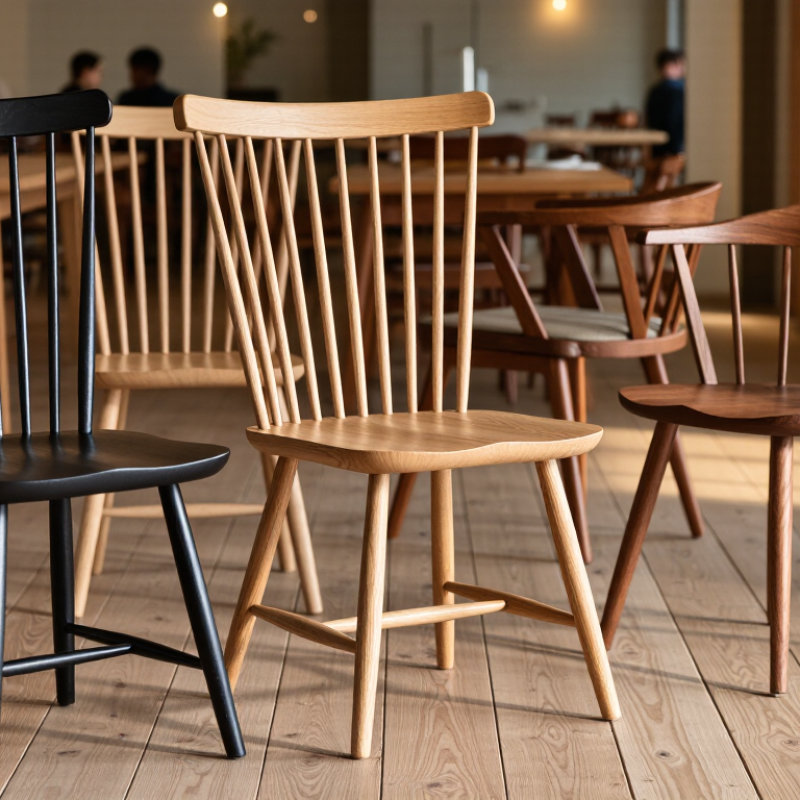
A Windsor-style chair is defined by its construction, not just its silhouette. The seat acts as a structural hub: turned legs and back spindles fit into drilled sockets, while stretchers brace the legs below. Many versions feature a shaped solid-wood seat, a steam-bent bow, and slender spindles. Details vary by region and period. Terminology is not perfectly consistent across markets. Ask suppliers for a joint diagram, wood species, and finish schedule—not only a front-view photograph.
The USDA Forest Products Laboratory’s Wood Handbook (FPL-GTR-282, 2021) puts wood’s average fiber-saturation point at about 30% moisture content. Below that point, moisture loss causes shrinkage, which can loosen poorly fitted joints. For inspection, check spindle seating, leg-to-seat fit, and glue lines underneath. A chair can look tight. It may still move. Request kiln-drying records and the target moisture content, then confirm the furniture has acclimated to its destination climate before assessing joint fit.
2026 Top Windsor Style Chairs for Global Buyers
Defining Windsor-Style Chairs and Their Core Construction
Windsor-style chairs are typically built around a solid seat, with turned legs and back spindles fitted into holes in the seat. The chart shows component counts for one representative Windsor side-chair configuration, not a universal specification.
Counts vary by chair design: spindle numbers and stretcher arrangements differ, and armchairs include arm supports. The defining construction feature is the combination of a solid seat and individually fitted turned components.
Tracing the Development of Windsor Chair Designs
Windsor chairs developed through practical changes rather than a single design breakthrough. In eighteenth-century England, makers fitted slender spindles and legs into a shaped wooden seat, creating a chair that was relatively light yet sturdy. The seat itself carried much of the structure. This construction differed from chairs built around a separate upholstered frame.
As the form crossed the Atlantic, regional workshops adapted it to local tastes and materials. Bow-back and comb-back designs gained distinct profiles, while turners shaped legs and stretchers on a lathe. Some chairs received painted finishes; others showed the grain of their wood. The details matter. A saddle-shaped seat, for example, can feel more supportive than a flat one, though comfort still depends on scale and fit.
Later makers explored variations in back height, arm shape, and spindle spacing. Not every chair followed. Surviving examples and historical descriptions do not always reveal exactly where a particular form originated, so neat timelines can be misleading. For buyers comparing Windsor styles today, looking closely at joinery, seat contour, and proportions offers a more useful guide than relying on a style name alone.
Identifying Major Windsor Chair Types and Their Features
Windsor chairs are identified by their shaped solid seats, turned legs, and slender spindles, rather than by one fixed silhouette. Bow-back models use a curved top rail that frames the back spindles and gives the chair a light appearance. Comb-backs have a straight crest with short upright projections, creating a more defined outline. Hoop-backs enclose the spindles within a broad curved rail. Small details matter. Check whether the crest feels smooth and whether the spindles sit evenly; uneven spacing can affect both appearance and perceived quality.
Sack-back chairs combine a rounded upper hoop with a low, supportive arm rail, while low-back versions keep the profile compact for smaller rooms. Many Windsor styles use splayed legs and a central stretcher for stability, though construction varies by maker and intended use. A useful buying check is to inspect the seat thickness, joints, and finish under natural light. Look closely. Dark coatings can hide grain, while pale finishes show dents more readily. These are trade-offs, not defects. Buyers should compare seat height and overall width against their market’s typical dining tables, since a familiar style can still feel awkward when its proportions are wrong.
Comparing 2026 Windsor Chairs for Global Buying Needs
Comparing Windsor chairs for global buying means looking beyond the familiar spindle back. A chair may appear traditional, yet seat shape, leg angle, and back height change how it feels after an hour. Try a sample, if possible. Ask for seat dimensions, overall height, and a clear view of the joints; photos rarely show looseness.
Material choice affects weight, appearance, and maintenance. Solid hardwood often handles repeated use well, while mixed materials may lower shipping weight or price. Neither is automatically better. Check how the finish responds to a damp cloth, and ask whether color variation is expected across batches. These details matter in hotels, dining rooms, and retail assortments.
For overseas orders, compare carton dimensions, protective packing, assembly needs, and replacement-part availability alongside unit cost. A low quote can become less attractive when packaging wastes container space or instructions confuse installers. Some buyers overlook this. Request a production sample and inspect for wobble, rough edges, and uneven finish before confirming volume. No checklist removes every surprise; a few details may still be missed.